

I recently submitted an application for a project that has long been sitting on the proverbial back burner. I’ve called it various things over the years - personal annual report / vibescape / yearbook / year in review / year in vibes / vibe report. It’s a visual and handmade template for reflecting on your year — completable in one sitting, heavy on feeling and vibe, designed to capture what you binge-watched, who you spent time with, the dramas that took over your life and the simple pleasure of that random Sunday you had no plans and things were nice and wouldn’t it be nice to note that somehow.
I’ve worked on my own Annual Report every year for years now, but I’ve never finished one due to some combination of perfectionism and indecisiveness and lack of technical skill and the reality that I have other things to do. I’ve shared the template with other people who have gone on to make their own versions. Katie made one for her and her family. Evan led a collective yearbook making session for a group of us who took a trip together.
I am not sure what the odds are on this specific application being successful, but it was a great forcing function for me to move this project incrementally forward, maybe not quite to the front burner but sort of balancing between the two. And one of the main lessons I’ve learned from my book report project is that if I want to do something, I should just do it and try to be scrappy about finding other people who might be interested in similar things rather than waiting for someone to give me funding / a book deal / permission. So regardless of whether this particular submission works out, I wanted to share with you an edited (redacted in some places, extended in others) version of it in case these ideas resonate with you.
TLDR:
-I’m interested in alternative ways of marking time beyond clocks and calendars
-I have been deeply inspired by Nick Felton’s Annual Reports of the 2010s
-I will never approach his level of detail and rigor in tracking. Also, I’m more interested in vibes.
-What follows is an attempt to articulate the what and the why behind this project and offer a starting point for developing a prototype. More like notes on the back of a napkin rather than a unified field theory.1
“We do not learn from experience... we learn from reflecting on experience.”
-John Dewey
“You’re looking for a cadence beyond the logics of social media and the metrics of capitalism. You want to engage your creative audience and community with, beyond, before the algorithm. You want to give yourself the gift of an archive and leave breadcrumbs for generations forward and back to find you, to find us - as you find yourself.”
-Ayana Zaire Cotton
“There is no political power without control of the archive, if not of memory. Effective democratization can always be measured by this essential criterion: the participation in and access to the archive, its constitution, its interpretation.”
-Jacques Derrida
Intro
The Qualified Self2: A More Tender Annual Report is a template for reflecting3 on the year and marking time beyond calendars and clocks. The framework helps individuals pause and tune into their lives through the act of self-inscription and results in an archive of attention that tracks experience more than data. It is predicated on the belief that life happens on a Tuesday: that our existence is made of ordinary, small moments alongside the grand milestones. It is the simple recipes of last summer and the winter grief that wouldn’t let go.
Taking as its inspiration the rigor and beauty of Nick Felton’s Annual Reports of the 2010s and suffused with the spirit of scrapbook culture, this project is intended to encourage a practice rather than a performance (eg social media/holiday cards). The template encourages individual personal reflection through a combination of forms (writing, drawing, collage); the format is intentionally visual and handmade. The practice offers a structure for slowing down and helping people process their lives through ritual and protocol.
It’s Already Happening
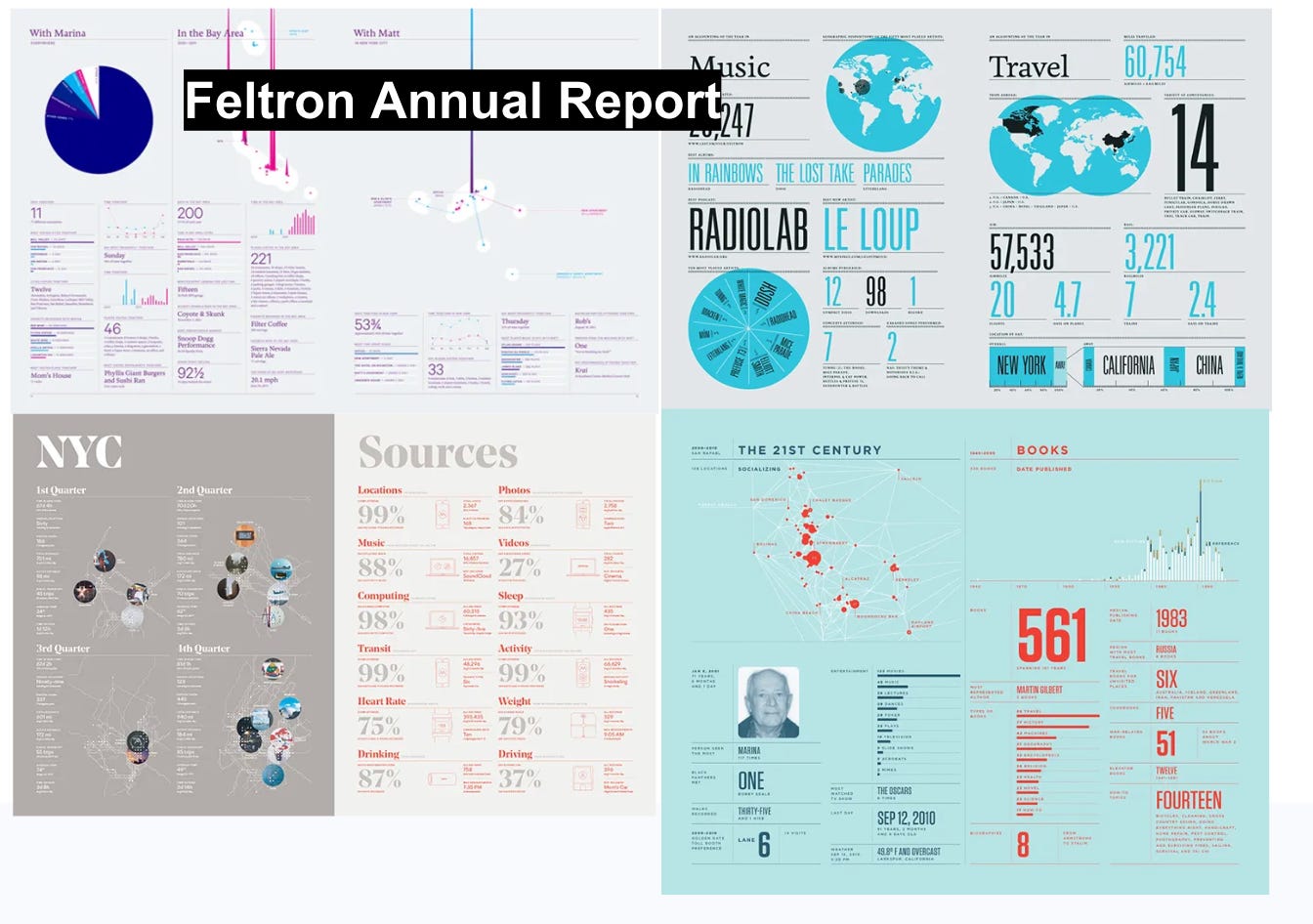
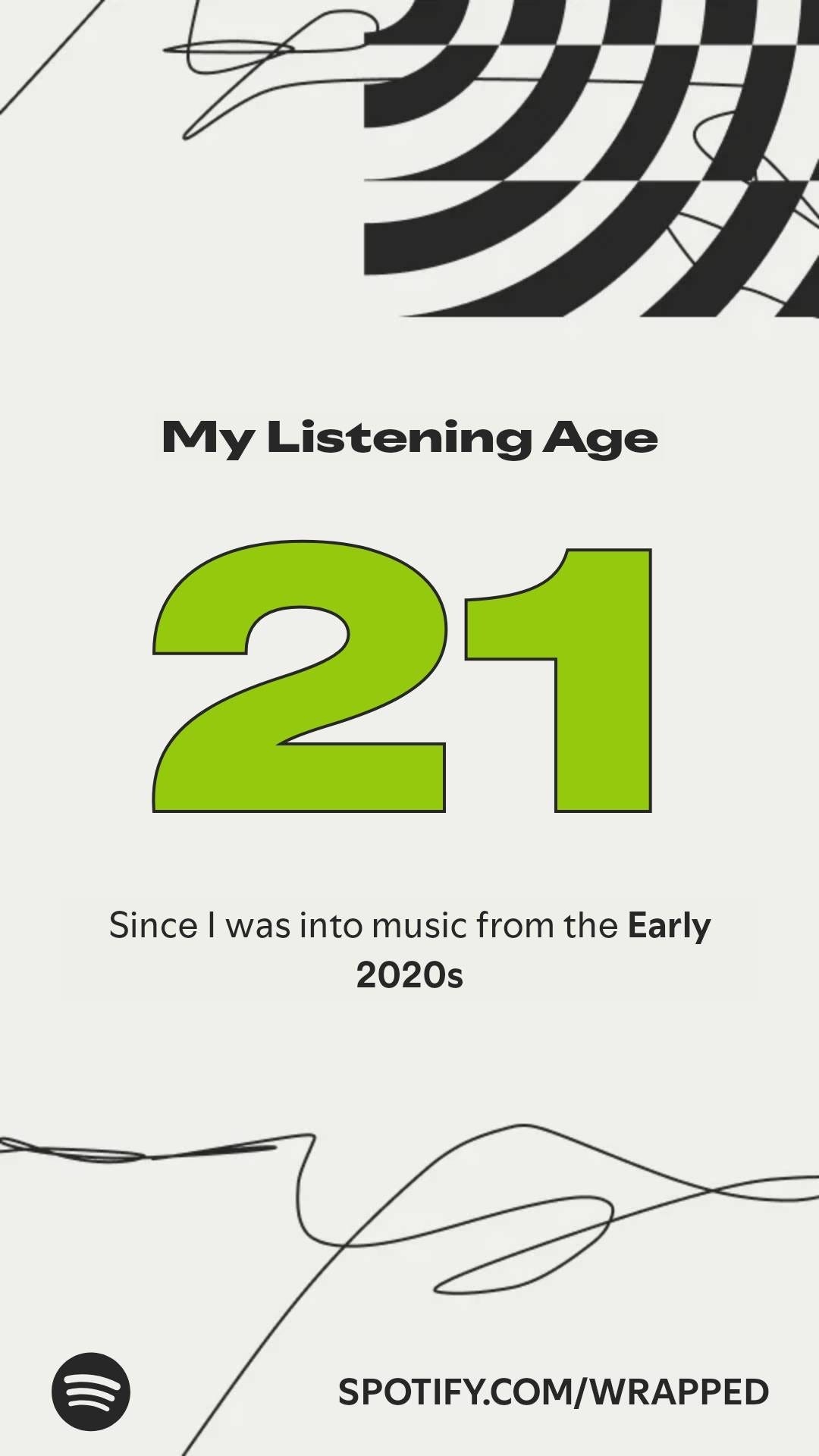
Nick Felton’s annual reports are a huge inspiration for this project but they require an attention to detail and fluency with data (not to mention time) that is unrealistic for most people. Tools have emerged that encourage introspection (Year Compass is one of my favorites), but most treat reflection primarily as a writing exercise. Even tech giants understand our desire to see the shape of a year. Spotify’s ‘Wrapped’ campaign helps listeners answer “what did this year sound like?” The summaries are visually dynamic, but only reflect musical consumption, not what we read or made or thought, who we were with, how we felt, who we are becoming.
Reorienting Time with Better Forms
Most year-in-review tools are organized around productivity logic - goals set, goals met. That is a very specific relationship to time, one that is linear and forward-moving and a conception of time as a resource to be managed, either well or poorly. In the Tender Annual protocol, time moves laterally, made up of feeling, texture, and the sensory and emotional experiences of a year. It is inclusive of triumphs but also of the small defeats and grievances that comprise the glorious, idiosyncratic specificity of each of our lives.
In my case, it would include the fan letters I sent and the ones that went unanswered, the story of a beloved ring that was lost (and later found!), all the things I tried - both helpful and inane - to handle my grief after a friend died. One year I had a category called Men Who I Am Not Married to or Related to Who Said I Love You.
Repairing the Archive to Better Imagine the Future
In the long wake of the pandemic, time has become so elastic; memory, unreliable. The social pressure to move forward inhibits us from reflecting on what happened before. We need better imaginative structures. The Tender Annual form shapes what we notice; in turn, what we notice shapes what we might do next or what we might decide to do differently the next time around. Self-inscription, practiced this way, is not retrospective. It is generative. And although its core is a ritual to mark time, there is a reparative aspect to this practice.
Archives are by definition limited and often inaccurate, curated to universalize a narrative from the experiences of a select few. In the face of increasing institutional erasure and forced algorithmic conformity, we have to write ourselves. This insistence on self-inscription is personal for me. As an American-born South Asian woman, I am less than 1% of the population. If I don’t write myself, no one else will.
“The story we tell becomes the world we live in.” - The Op-Ed Project
Next steps, tentatively: 1. exploring tools and products that might already exist 2. finding a design partner 3. vibe coding???? Any other ideas?
As you’ll note, I’m still not settled on this project’s name and am trying out a few different ones, but there is a great book with this title: The Qualified Self: Social Media and the Accounting of Everyday Life by Lee Humphreys
I recently learned - via this lovely interview between Ezra Klein and Gary Shteyngart - that Marc Andreeson doesn’t believe in introspection. From the transcript:
“There’s been a fascinating recent trend among Silicon Valley types where they’re on a tear against interiority.
You had Marc Andreessen talking about how he doesn’t want to have interiority. He doesn’t want to have introspection, which he described as looking backward — which is not quite what it is, but nevertheless.
Archival clip:
Interviewer: You said something that I love, and I never hear other entrepreneurs think about, talk about, but I think it’s super-important — that you don’t have any levels of introspection.
Marc Andreessen: Yes. Zero. As little as possible.
Interviewer: Why?
Marc Andreessen: Move forward. Go. Yeah, I don’t know. I’ve just found people who dwell in the past get stuck in the past. It’s a real problem. It’s a problem at work, and it’s a problem at home.”
"This was from my 2025 Spotify Wrapped. I am not sure whether to feel proud or embarrassed."
I LOL'd.
there is so much here about archives and futures that i have been deep in thought about that we MUST NERD OUT ABOUT SOON... until then
XO
This is an absolutely marvellous concept - I love thinking about archives, particularly personal archives, in this way. The more fragmented, feverish and blurry the better (à la Julietta Singh, Susan Howe, etc)