
How to Get Creative in 2026
On low stakes and fake deadlines

I recently did my first book event of the year - Mothering as Creative Practice - with Christina Pappas of Same Page SF at Black Bird Bookstore. Black Bird is in the Outer Sunset in San Francisco where the city meets the ocean, so there was a very lovely we’re-all-in-this-together-at-the-edge-of-the-continent vibe to the whole thing.
One of the things that struck me during the Q&A and especially in the private conversations afterward is that so many questions boiled down to some version of the same thing: How did you do this? And although the this is my book report, the real this that they’re asking about is the project that is squirreled away in the back of their brains/the corner of their hearts. Kind of forever on the back burner. Or, in some cases, very close to the front burner but for a few questions that are sometimes existential (am I an artist?) and sometimes practical (how do I start?).
And because part of my own work is about making the process of creativity more legible to more and more different kinds of people, I wanted to get more specific about the actual how of getting started, keeping going and — perhaps hardest of all — finishing a piece of creative work. Think of these notes as Part 2 of my proto-manifesto on creative practice: Time, Space & Childcare.
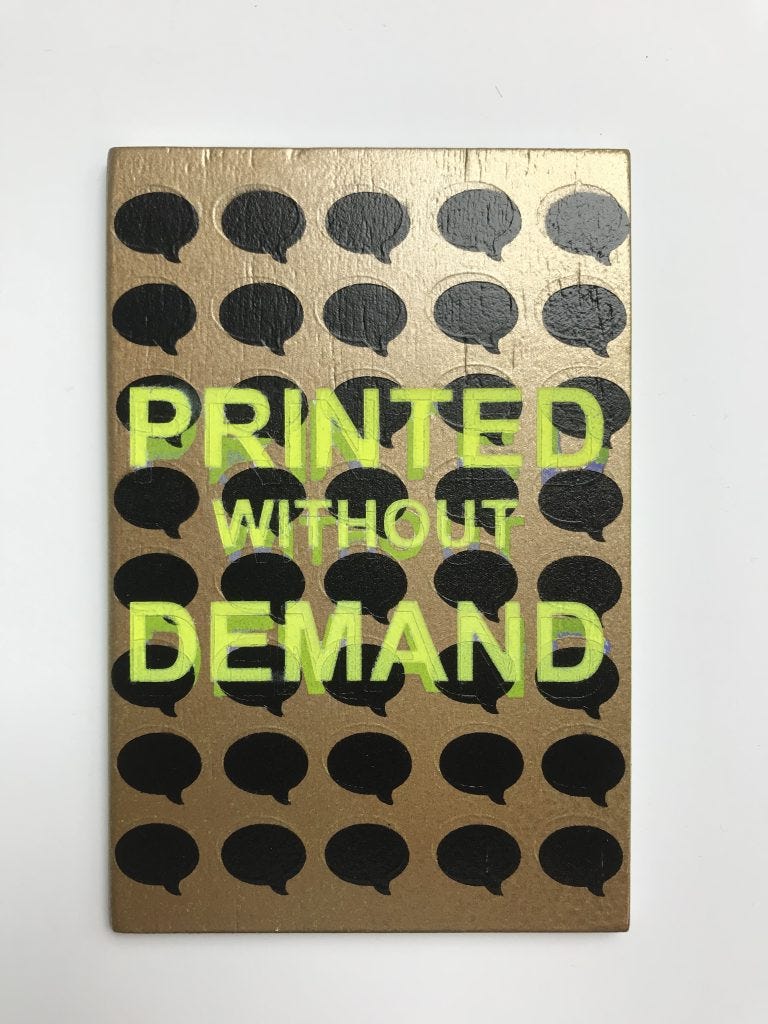
Permission - I have learned that my own project is a lot about permission, mostly the permission I gave myself to work on something useless. Give yourself permission to do something that no one else asked for. Printed without demand.
A Simple Form - I really struggle with a blank page/empty canvas/the freedom to make whatever I want. What I prefer instead is creative constraint in a simple form. The Emergency Was Curiosity started as a response to another book, and while it became much more than that, responding to something else as a start really helped put some constraints on what would have otherwise felt too open-ended.
Make Up a Deadline - Since there’s no real reason for any of this, I’ve found that I’ve needed to make up fake deadlines for myself. Sometimes, I use an upcoming event as a forcing function to create something new. I always assumed that it was supposed to work the other way around: you make a thing and then host an event to share it. But in my case, the fact that an event is happening on a specific date gives me a reason to have to make (and more importantly, finish) something. So, for example, I drafted the Time, Space & Childcare talk after being invited to participate in Bathers Library’s Summer Symposium.
Make Something for Yourself - I was able to start my project because I was making it for myself. There was no one else I needed to please. I wasn’t worried about an external audience or how it would be received by anyone else because the audience was me.
Center Your Own Delight - Relatedly, paying attention to myself as the audience helped me make creative decisions throughout the project, particularly when editing. Did I like it? Keep it in. Does it need to be there? Who cares? Because the project was and is so idiosyncratic and personal (read: without a market), I got to focus on my own delight rather than say what the market needed. It reminds me of Tamara’s 365 buttons: “Hey so it actually only has to make sense to me for me to do it and I don’t feel like explaining it to anyone else.”
Make Something for One Other Person - More recently, I’ve been working on a project that I’ve been having trouble finishing - a zine about mothering and creativity. When I mentioned this to Christina, she said she’d love to see it and suggested that perhaps I could share a draft with her. Making something just for her took the pressure off. When I imagined the project as a bigger thing — a final draft, finding a designer, getting it printed — it was paralyzing. When I imagined making the zine for an audience of one, knowing Christina would be both interested and forgiving, it was all I needed to actually finish a good enough draft.
Keep the Stakes Low - For the time being, the stakes for my creative work are pretty low. It’s not how I make my money; there’s not a lot of reputational risk in it (I don’t think :). For the most part, if someone is not into my small, weird projects, it doesn’t really matter. It usually just means it’s not for them. I don’t take it too personally. I’m not aiming for a New York Times bestseller. I’m usually making just a few hundred copies of a thing mostly for people who already know me. All of this has helped me be serious about the work without taking myself too seriously.
Be Serious about the Work, but Don’t Take Yourself Too Seriously - It’s easy to get into your head about creative work. But even if your creative work is personal, it’s not you. You are more than your work.
These notes are specifically about starting and keeping up a creative practice. They are not about selling creative work or about making a living from creative work, perhaps topics for another day. So, in case it’s helpful, I also want to mention some things you don’t need if all you’re trying to do is make some thing.
Some Things You Don’t Need:
A market
An audience
A reason
If you’re working on a creative project and want to talk to someone about it, let me know. I can give you a deadline; I’ll be your audience of one. Permission granted.
I love this entire list. Especially #5 and the 365 buttons quote. I can barely explain my own weird, small, creative projects to myself let alone other people but hey maybe I don’t need to! I can just enjoy them freely!
I love this library, and, as always, I love your thoughtful and wildly thought-provoking write-ups! "Center your own delight" is really resonating with me today.